How Gluon looks on paper and slides.
The rules behind every deck, one-pager and brief about Gluon. Colours, type and drawings come from this website and the product, so a slide and a screen read as one company.
Space opens.
Paper explains.
Two grounds do all the work. The dark one makes the promise, the light one proves it.
The orb and the wordmark.
Blue ink on light, white on blue.
One mark in two colours. The app icon covers square spots; the orb alone is a small footer mark.

Do
- Clear space of half the orb’s width on every side.
- Smallest orb: 16 px on screen, 5 mm in print.
- Wordmark always lowercase Space Grotesk 600.
Don’t
- No tile, outline, glow or gradient on the orb in a lockup.
- No colours other than navy ink and white.
- The retired G tile never returns.
Five grounds, three accents.
One accent per page.
Gradients only come from the space backdrops. Everything else is flat. The collateral build reads these values from the same tokens as this website.
Grounds
- Space#060A13 · Covers
- Navy#0A1E5C · Trust, closing
- Electric#0B2FC2 · One CTA band
- Paper#F8F9FC · Content
- White#FFFFFF · Cards, tables
Ink and accents
- Ink#121829 · Body
- Muted#647089 · Line two
- Blue#0D6EF2 · Accent on light
- Cyan#9BDFFB · Accent on space
- Signal#FFC21A · Accent on navy, CTA
- Pink#E53F89 · Rationed
Three faces,
one job each.
Slides: statement 66 to 80 pt, title 40 to 44, body 16 to 18, stat 54 to 60. A4 print: title 30 to 34 pt, body 9.5 to 10.5.
- DISPLAYSpace Grotesk Bold · -0.04em · 1.04
- Connected. Governed. Useful.
- BODYSwitzer Regular and Semibold · 1.5
- Gluon connects business context, permissions and source evidence in one knowledge foundation, so your people and AI can work from the same understanding.
- LABELIBM Plex Mono Medium · capitals · 0.08em
- 03 / Trust is the foundationBook a demo ↗
Two lines.
The second one turns.
Every title has a numbered mono eyebrow above it. Statements on space are set in capitals. Headings say what the reader gets; the wit lives in the body copy.
Your company’s knowledge.
Connected. Governed. Useful.
Connected doesn’t
mean wide open.
Blue ink explains.
Type does the talking.
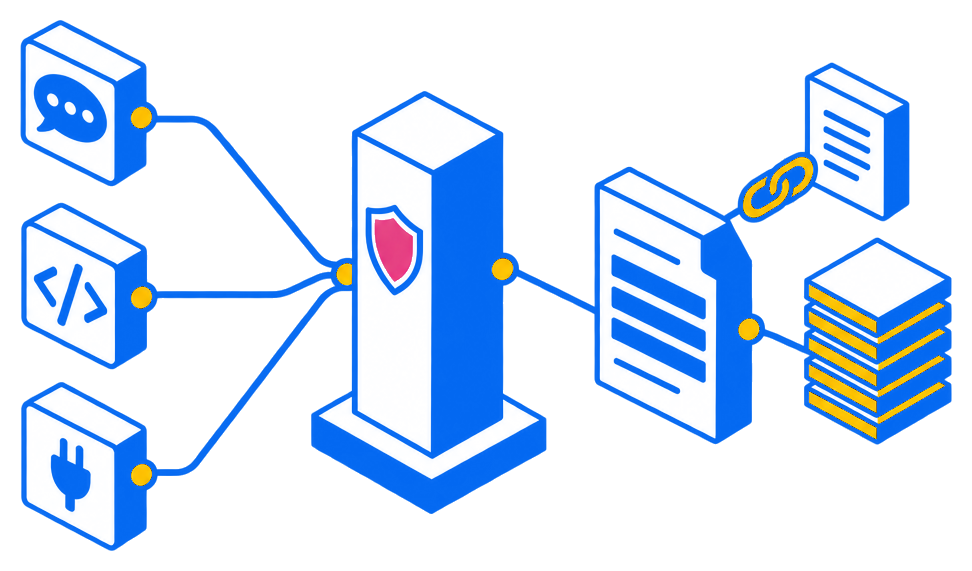
Navy outlines, white or solid navy faces, isometric volumes, one yellow or pink accent, no text and no people. On paper the drawing sits on the ground; on navy it sits on a white card.

Connected knowledge 
Governed access 
Reviewed publishing 
Deployment boundaries
A small kit,
used the same way everywhere.
Stats, numbered proof, calls to action, chips, cards and hairline tables. Nothing else is needed.
- 1permission path for chat, API, MCP and desktop
- 26kinds in the GOL ontology language
- 0answers without a source
- 01
Access checked before knowledge is retrieved.
- 02
Sensitive fields masked by policy.
- 03
Answers connected to their sources.
See the connections.
Map your business in its own language. Connect people, contracts, projects and the knowledge between them.
| Surface | Permission | Audit |
|---|---|---|
| Chat | Same policy decision | Hash chained |
| API and MCP | Same policy decision | Hash chained |
Eight slide templates.
16:9, 0.7 in margins, eyebrow on top.
Every template is a slide in the PPTX. Copy it into your deck and replace the text.
Cover · space Statement · planet Content with drawing Three cards Numbered proof · navy Stat row Hairline table Closing · CTA
Plain headings.
The edge lives in the body.
Collateral speaks like the product: concrete, sourced and in the words people see on screen.
Write
- Headings that say what the reader gets: “See it on your own data”.
- Concrete numbers with their source over adjectives.
- A long sentence that builds, then a short verdict.
- Domain, Object, Link, Action: the words the product uses.
Avoid
- Em dashes, and “seamless”, “robust”, “unlock”, “elevate”, “effortless”.
- A product that does things by itself: “The ontology designs itself”.
- More than one “X, not Y” contrast per page.
- DDD vocabulary (aggregate, bounded context) in collateral.
Change the source.
Rebuild everything.
The collateral is built from the same sources as this website. Change one, run the build, and every PDF and deck follows.
- 01
Tokens marketing/brand/tokens.css and the website’s global.css
- 02
Mark web/apps/website/src/assets/orb-silhouette.svg
- 03
Drawings The website illustrations and marketing/brand/empty-states
- 04
Run uv run marketing/src/build.py, as marketing/README.md explains