Gluon's MCP server lives at https://gluon.example/api/mcp. It speaks JSON-RPC over streamable HTTP with plain JSON responses and negotiates protocol versions 2025-11-25, 2025-06-18 and 2025-03-26. Calls go through the same policy engine and retrieval as chat and the REST API, with context.channel set to mcp. A policy that lists only chat, apps and api therefore allows a read in chat and withholds the same read over MCP.
Connect a client
- Have an administrator approve the client with the Capabilities it needs (see Approve OAuth clients and handle rate limits). A client that publishes a Client ID Metadata Document, such as Visual Studio Code, is approved by its metadata URL.
- Point the client at
https://gluon.example/api/mcp. Its first request without a token gets 401 withWWW-Authenticate: Bearer resource_metadata="https://gluon.example/.well-known/oauth-protected-resource/api/mcp", which a compliant client follows to start the sign-in. - The person signs in to Gluon in their browser. The client receives a token bound to the MCP resource and to that person, and uses it on every call.
What the client is offered
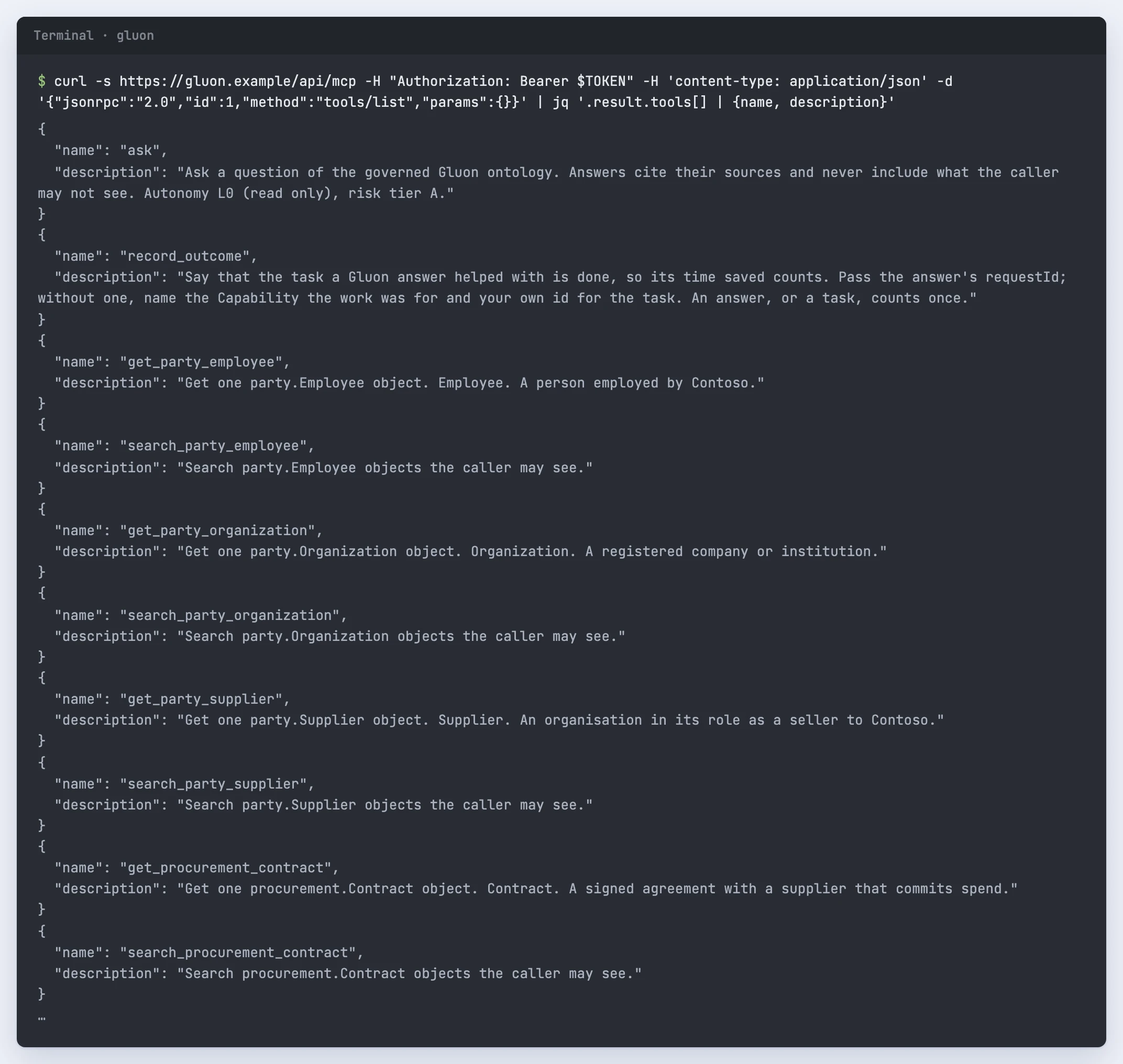
tools/list returns:
ask: a cited question over what the person may see (autonomy L0, risk tier A). It takesmode,fastoraccurate: fast runs one search, accurate searches further and takes longer. Without it, the Capability's default applies, else fast. A Capability that pins a mode refuses the other one.record_outcome: the task an answer helped with is done. Pass the answer'srequestId(one of the person's own answers), or thecapabilitythe work was for with your owntaskId. An answer, or a task, counts once. Gluon's Drift report counts these as verified completions for time saved; the REST equivalent isPOST /api/outcomes.get_<type>andsearch_<type>for every object type the bound Capability reads, for exampleget_procurement_contractandsearch_procurement_contract.get_takesid;search_takesqueryandlimit(default 20).- One tool per action and function exposed on
mcp. Its description states the effective autonomy level and risk tier.
resources/list returns the views exposed on mcp as gluon://views/<name>; read one with resources/read.
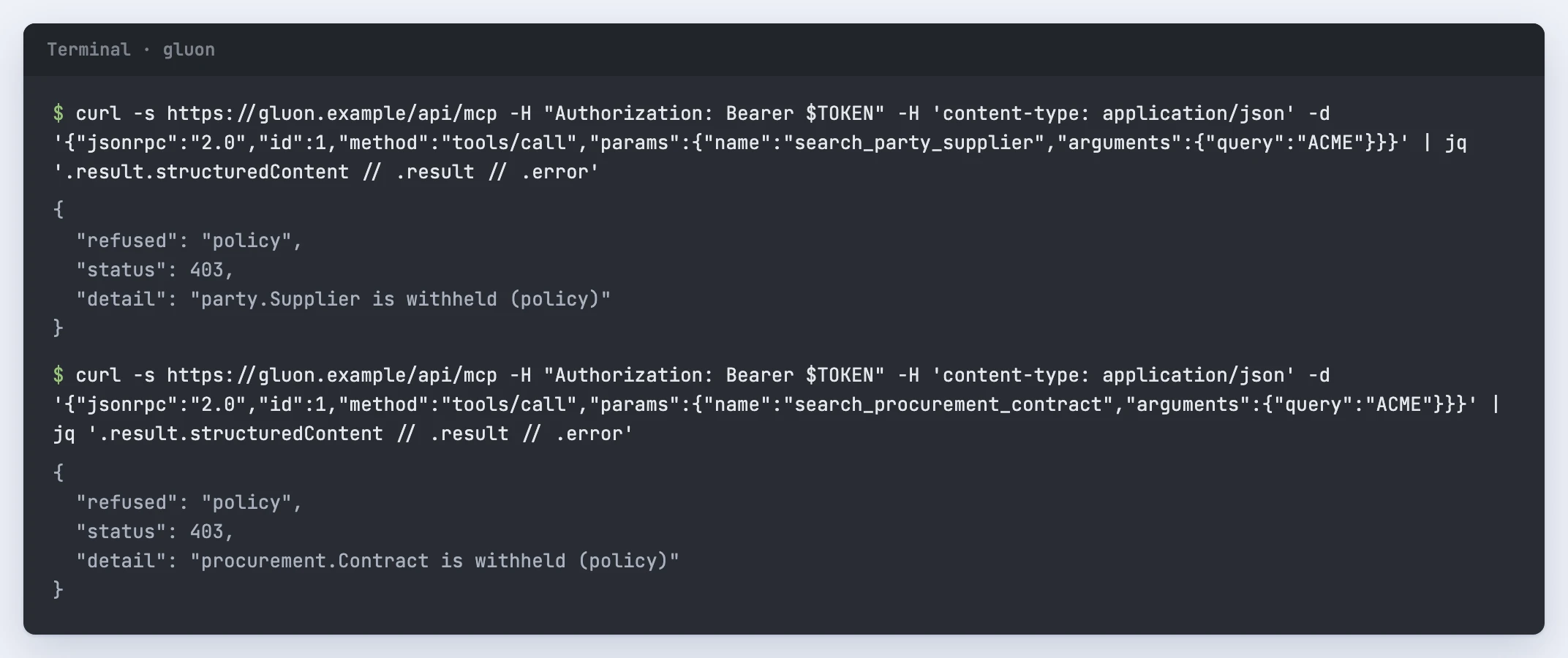
A withheld element is listed and refuses when called. Anything outside the person's segments is absent from the tools, the resources and every count. Each tool takes an optional capability argument; leave it out when the client has one approved Capability offered to the person.
Call a tool
curl -s https://gluon.example/api/mcp \
  -H "Authorization: Bearer $TOKEN" \
  -H 'content-type: application/json' \
  -d '{"jsonrpc":"2.0","id":1,"method":"tools/call",
       "params":{"name":"search_party_supplier","arguments":{"query":"ACME"}}}'
A result carries text content and structuredContent. A refused call is still a tool result, with isError: true and structuredContent such as {"refused": "policy", "status": 403, "detail": "party.Supplier is withheld (policy)"}, so the model can tell the person why. A refused resources/read is a JSON-RPC error instead: -32001 when withheld, -32002 when absent.
An action tool needs the execute scope and goes through the same pipeline as the REST API. It answers pending-approval with an approvalUrl when an approver must sign off, and calling it again with the same parameters returns the same run.
Transport rules
GET /api/mcpanswers 405, since the server sends no stream of its own.- A request whose
Origindiffers from Gluon's own is refused with 403, which also keeps browser-based clients on other origins out for now. - An
MCP-Protocol-Versionheader naming another version is refused with 400. - Malformed params get
-32602; a body that is not a JSON-RPC object gets-32600. - A
contextsent in tool arguments is dropped and audited asapi.client-context-ignored.
Rate limits and revocation work as on the REST API: 429 with Retry-After past the client's limit, and a revoked client, grant or person fails on the next request. While ask composes an answer, Gluon re-checks the token and the person's access at every chunk.