An answer is only as good as the index behind it. Three screens in the admin console tell you whether search is up, whether each source is current, and what the PII masker hides.
Test the storage adapter
- Open Storage, models & API > Storage and models.
- Under Storage adapter, check where search lives. On Elastic the card shows its URL, the user and the key-service reference for its password. On pgvector (Postgres with the pgvector extension) it shows the database and the search table, such as
gluon_search_1536(one table per vector size). - Click Test connection.
On pgvector, the first Test connection on a new database creates the extension and the search tables. If the server's database user may not create the extension, the result says so: ask your database administrator to run CREATE EXTENSION vector once.
The adapter and both Postgres databases (master and audit) each answer "Connected in n ms" or show the exact error. The adapter and the databases are set in the server configuration and shown read only. While the adapter is down, chat says search is unavailable and the health page reads Degraded.
Check how fresh each source is
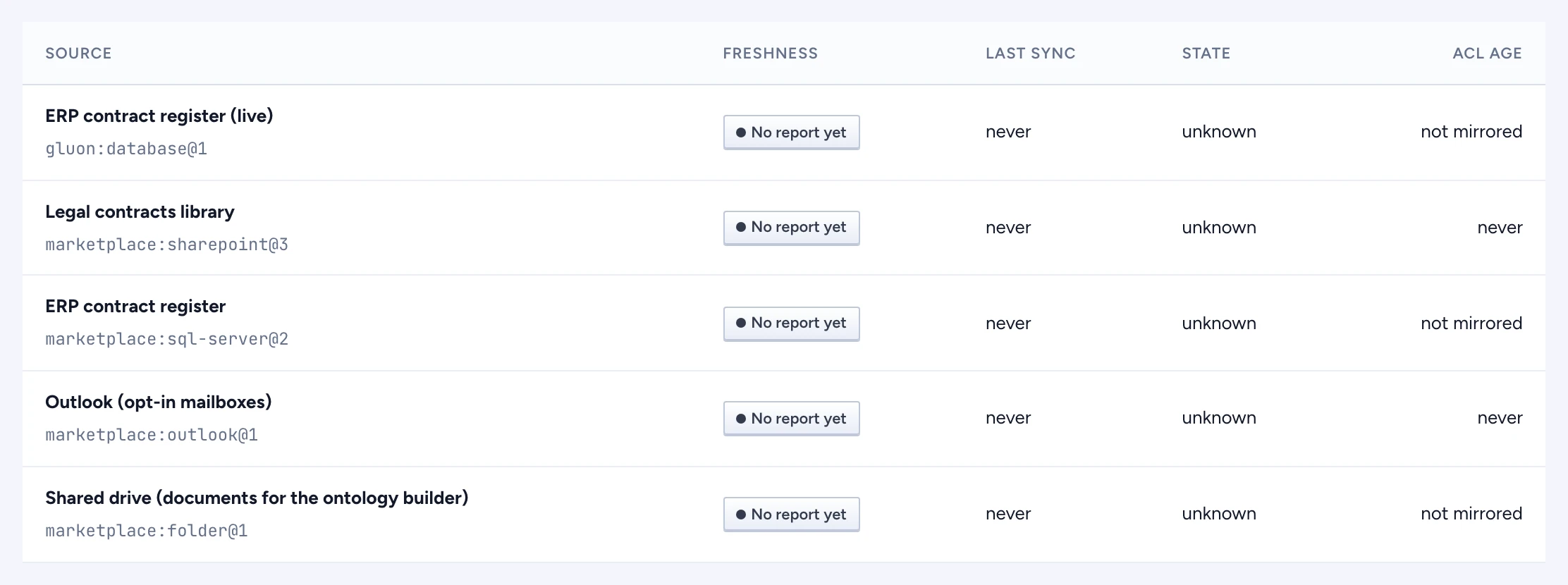
Open Health & pipeline > Connectors. These connectors push records to Gluon and report their state; Gluon does not pull from them. Databases and MCP servers that Gluon reads itself at question time are on their own page: see Connect a database or an MCP server. Connectors links there at the top. The Sources table shows each source with its connector, Freshness, Last sync, State and ACL age.
- Fresh: the last successful sync falls within the source's
freshness.expect. - Stale: older than
expect. Answers that cite the source say so. - Data alert: older than
alertAfter. The source's owners get one data alert per breach. - No report yet: the connector has never reported. Answers treat it like a stale source.
ACL age is the age of the permissions mirrored from the source. "not mirrored" means the source mirrors none. A mirrored ACL that never synced counts as breached on the health page.
A Source declared in GOL gets its records from a connector, which reports through POST /api/sources/{name}/status with an API key scoped connector:status:<source name>, one per source. To ask a connector to resync its permissions, a security officer uses Resync in the Access explainer's freshness list. Fix a stale source at its connector: widening a policy leaves the evidence just as old.
If the first-run wizard loaded the sample, Connectors also shows Sample data with Remove the sample data. Remove it before a real connector indexes Contracts or Suppliers: the starter policy covers every Contract and Supplier record in the environment.
Test the PII masker
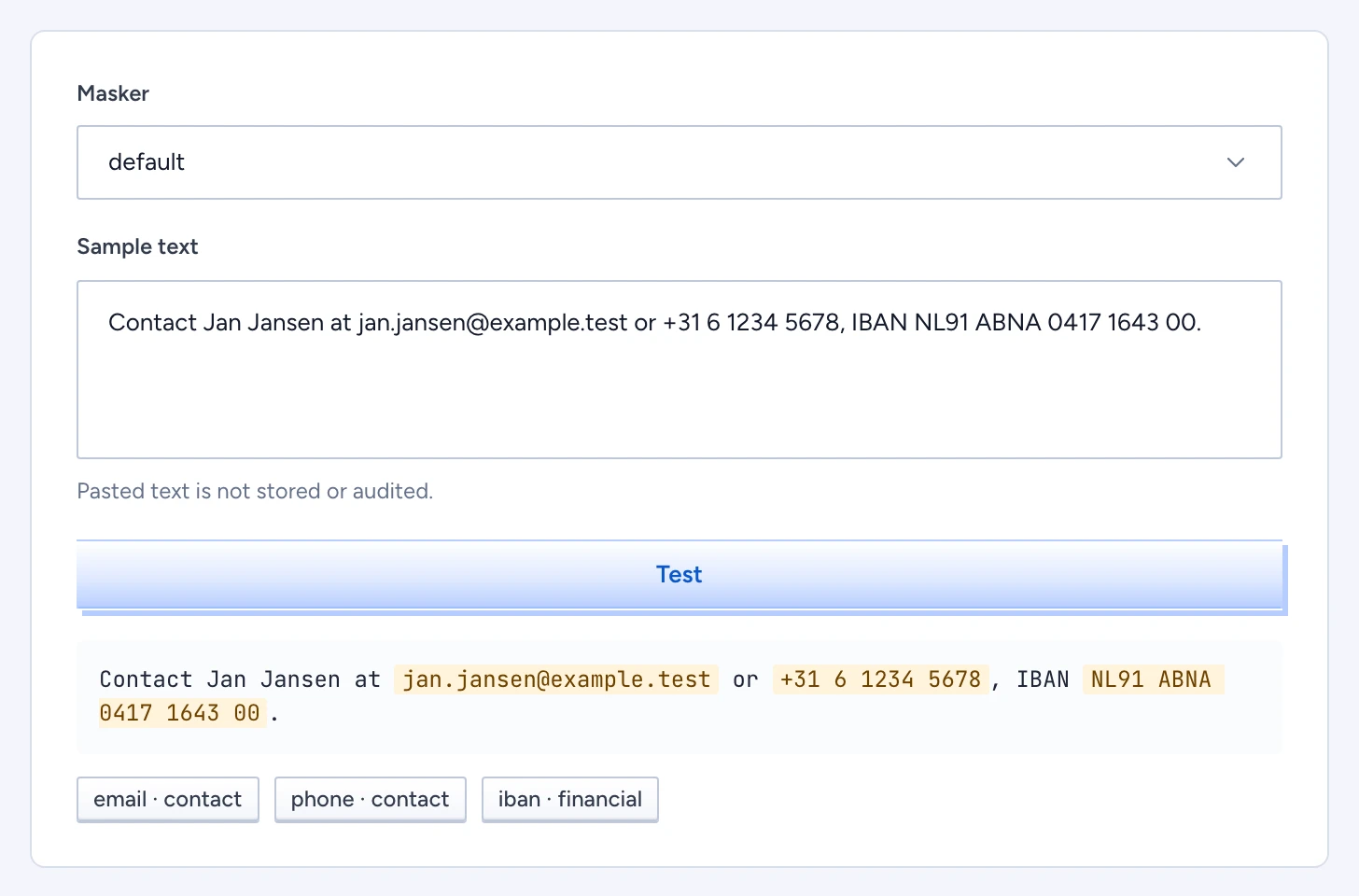
- Open Storage, models & API > PII masker.
- Choose a Masker.
defaultfinds email addresses, phone numbers, IBANs (checked with mod 97), card numbers (Luhn) and BSNs (the eleven test).strictadds postcodes and dates of birth. - Paste fictional text into Sample text. Nothing you paste is stored or audited.
- Click Test.
The result highlights each match and lists its rule and category, such as iban · financial. The page also lists the Sources that use each masker. A Source picks its masker in GOL (pii.masker), so switching it is a proposal in the designer. The rules inside each masker are fixed.